
How To Reduce AI Cybersecurity Risks

By: PCR Business Systems
Artificial intelligence is changing cybersecurity in ways that are hard to ignore, even for companies in non-tech industries. As we move into 2026, business owners need to understand new risks that come with the Age of AI.
For years, hackers had to be patient and skilled. It took time and effort to break into a network. They had to craft their own phishing emails, write their own malware, and spend hours identifying a company’s cybersecurity vulnerabilities. Today? Cybercriminals can use AI to do most of the work for them. That means more attempts to steal your emails and passwords, more attacks on your networks, and more work for business owners to train staff on what to look for.
The growing trend of AI cyber-attacks is something Northeast Ohio business owners can’t ignore. Every Akron business is a potential target, no matter the industry or how big or small the company is. Hackers only care about one thing: opportunity. If there’s a vulnerability, they will use AI to find and exploit it. And if there’s a human who can be tricked, they will try.

Terrifyingly, AI can now pull publicly available details about your employees, including job titles, vendor relationships, upcoming events, the tone you use in emails, and more, and then craft phishing messages that are extremely hard to differentiate from the real thing.
This has been a real problem for years, and we’ve had companies come to us after being tricked into wiring money into a fake account, but it’s only going to get worse. AI can mimic voices with shocking accuracy, including the voice of your CEO asking for a quick wire transfer. It can scan the open internet for outdated software faster than a person could scan a single network. And it can generate malware that mutates every few minutes, making old-school antivirus tools almost blind.
While it is unsettling, there are warning signs to look out for and precautions that can be taken. It starts with knowing and understanding the risks Akron and Cleveland businesses are facing and then training your employees to be extra vigilant moving forward.
Here are some of the new AI cybersecurity risks to Northeast Ohio companies:
- Phishing that sounds like a corporate executive or someone you know. These messages now look and sound cleaner, more personal, and almost like a coworker typed them while rushing out the door.
- Voice or video requests that feel urgent. AI impersonations are getting harder for employees to question because they are so realistic, especially if the request seems reasonable or involves a client or potential transaction that has been discussed internally.
- Unusually fast, repeated login attempts. This often signals an automated AI agent trying thousands of variations to access your systems.
Malware that slips past antivirus tools. If a threat keeps “coming back” after cleanup, you may be dealing with adaptive code. - Small issues piling up. A single IT person cannot outpace an automated threat running 24 hours a day. One little mistake, like a missed patch, a late update, or slow response time, could be all it takes for AI to breach your cybersecurity.
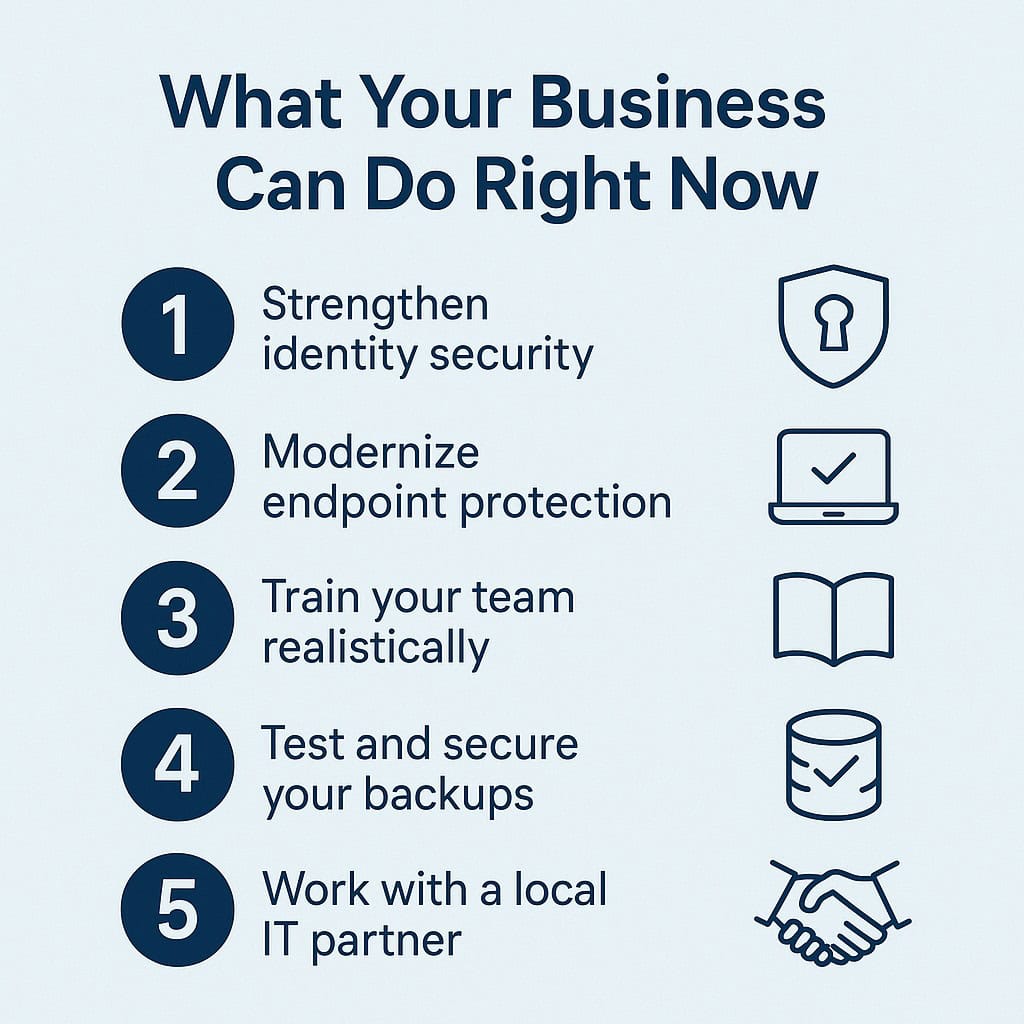
Now that you know what to look out for, the next step is taking practical steps to defend your business against AI cyber-attacks. Here’s what companies in Akron, Canton, and the surrounding region can do right now to protect themselves from AI-driven attacks:
- Strengthen identity security.
Turn on MFA on all devices. This is especially important for employees who work from home and have access to their work laptops or cell phones outside of the office. In addition, be sure to remove old admin rights and use conditional access if you’re in Microsoft 365. - Upgrade your endpoint protection.
Traditional antivirus tools will simply be outmatched in 2026; they already are. Endpoint Detection and Response (EDR) or Extended Detection and Response (XDR) gives you behavioral monitoring, which is a fancy way of saying it watches for suspicious behavior, not just suspicious files. - Simplify staff cybersecurity training
Your staff doesn’t need to become cybersecurity experts; they just need to know what to look out for and follow the rules when it comes to cybersecurity best practices in the age of AI. In other words, they can’t be lazy with your company’s online security. - Test backups regularly.
The only backup that matters is the one you can restore. Off-site, immutable, protected backups are the gold standard now. - Bring in a local cybersecurity partner before a crisis hits.
You want a cybersecurity partner that proactively protects your networks before a breach can occur. And you want someone local who knows your environment and can be on-site if needed. This is why more Akron businesses are leaning into co-managed IT and cybersecurity services like what we offer at PCR Business Systems. This is not because their internal IT team isn’t capable, but because threats no longer clock out at 5 PM, and it often takes a higher level of cybersecurity than most in-house teams can provide.

Time will tell how we use AI for everyday business. Hopefully, we’ll find ways to use it for good and increase production while working alongside our employees.
Unfortunately, cyber criminals have already figured out how to leverage artificial intelligence against us. And while Northeast Ohio business owners don’t need to chase every headline or necessarily become AI experts, they do need to know what to look out for and be prepared. It starts with a solid cybersecurity foundation, the risks, and a trusted Akron IT company that can help provide your company with the highest level of cybersecurity controls.
Schedule a meeting with PCR President Pat Carroll to understand more about AI cybersecurity risks facing Akron businesses and what you can do about it.
